News | 11.05.2026
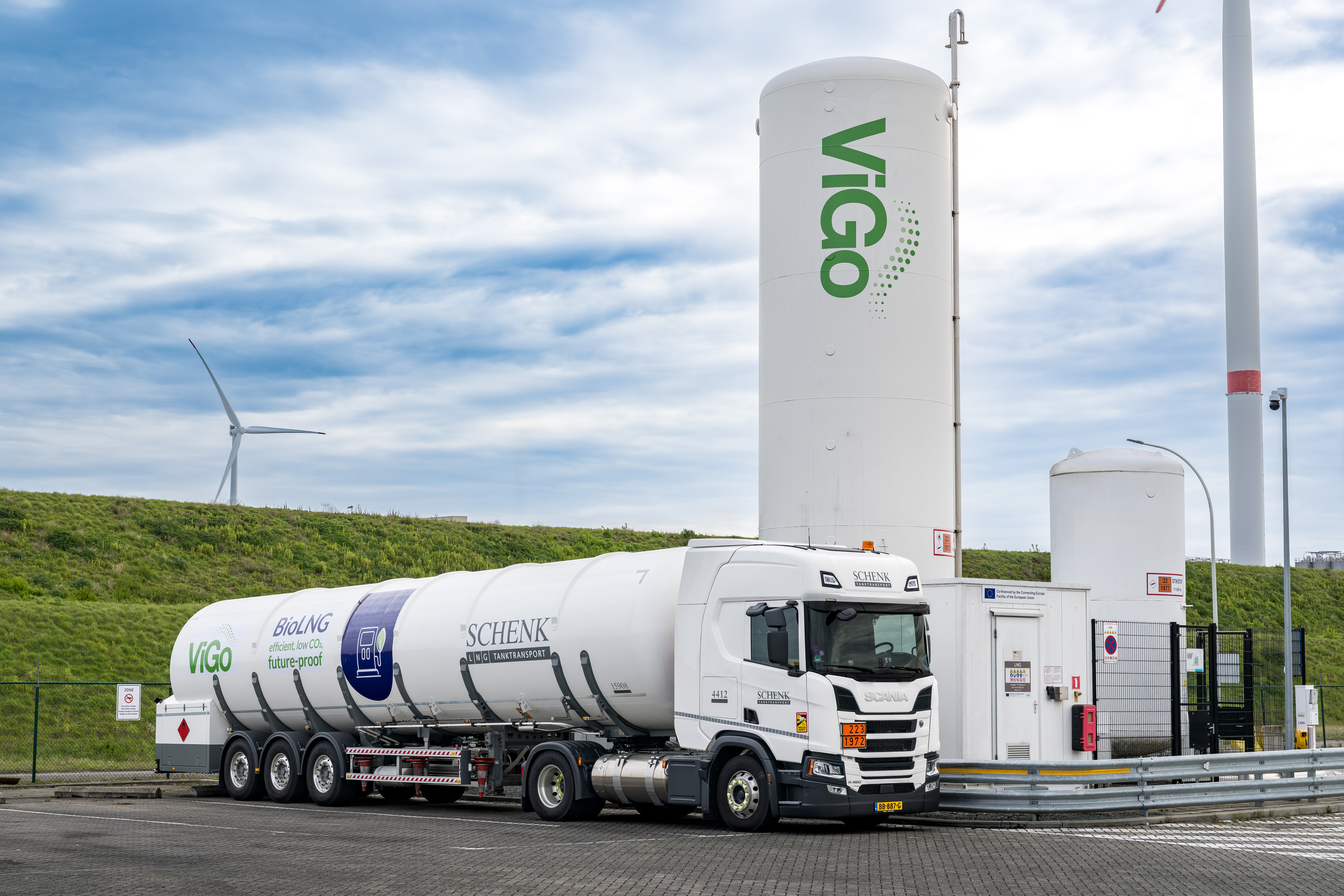
Schenk Tanktransport and ViGo Bioenergy have just launched their first co-branded trucks. Travelling initially on routes through Italy, Germany and the Netherlands, and fuelled by and transporting ViGo’s bioLNG, this venture aims to spread far and wide the sustainable transport vision shared by both companies.
Here we talk to Jan Peter de Haan, sales executive at Schenk, about the collaboration and what makes it so special.
Tell me a bit about Schenk as a company.
Schenk is a leading European logistics specialist, transporting liquid and gaseous products for sectors such as energy, chemicals, food, and industrial gases. It was founded as a family business 100 years ago, with a strong belief in the value of people and partnerships. The safety of our people is paramount which ties in to our absolute focus on high standards in safety and technical expertise.
What is your vision for sustainable transport logistics?
We have a clear vision to become the European market leader in sustainable tank transport; aligned to EU guidelines we’ll be net zero by 2050 and halve our emissions by 2030 compared to a 2021 benchmark.
We want to offer the best and most sustainable supply chain solution for our customers so this approach is integrated throughout our business, from operational changes and fleet optimisation to new technologies and renewable fuels, each element has a part to play in creating a sustainable, low or no carbon solution.
Schenk’s decarbonisation vision is ambitious, multi-technology-driven, and rooted in client partnerships. BioLNG plays a vital role as a mature, effective solution for immediate CO₂ reduction, particularly when integrated into local circular systems.
However, Schenk recognizes that no single fuel will deliver full decarbonisation, and so continues to innovate and diversify across multiple green transport technologies.
Why did you choose to work with ViGo? What makes the collaboration a good fit?
We chose to work with ViGo for a number of reasons, our shared belief in the role of bioLNG in the decarbonisation of heavy transport, our shared priority of a safety-first culture and our belief in the value of true collaboration as the basis of successful partnerships.
We believe that bioLNG plays a crucial but not exclusive role in Schenk’s decarbonisation strategy; it has a high CO₂ reduction potential, and is scalable, particularly as decentralised production of bioLNG rises. For us, however the most exciting aspect is the circular logistics. By partnering with ViGo who produce their own bioLNG, we create a closed-loop supply chain – ViGo trucks are fuelled by ViGo’s own renewable gas – you can’t get much more sustainable than that!
Having a shared vision feeds into our wider collaboration; we have clear lines of communication and a pragmatic, hands on approach to problem-solving. Our planning team and drivers are at work seven days a week for ViGo so the relationship has to be transparent and solutions-focused. We’ve also been working for ViGo since it’s creation as Liquind back in 2015 so we have a long history of working together successfully.
“Over the years, we have built a strong and trusting relationship with Schenk. We share the same vision for a more sustainable future in transport and a common goal to create smart and future-oriented logistics solutions.
Our partnership covers many areas and is based on regular, open communication. We truly value Schenk’s expertise, their honest feedback and their practical way of working. That’s what makes the collaboration so successful.”
-Fabian Paul, Head of Downstream Operations, ViGo Group
What do you wish people understood better about decarbonisation?
One thing I wish more people understood is that decarbonising heavy transport isn’t a one-size-fits-all process — and it’s definitely not as simple as just switching fuels.
It requires a deep, realistic understanding of how our sector works: we move dangerous goods, often 24/7, with very little room for downtime or failure. That makes adopting new technologies a careful balancing act between ambition and operational feasibility.
The main barriers we face include technological maturity, infrastructure gaps, and economic viability. Take electrification, for example — promising, but not yet suitable for long-haul heavy-duty transport due to battery weight and charging times. Hydrogen internal combustion and biofuels like bioLNG and HVO100 offer better near-term options, but they come with their own challenges, like high costs and inconsistent availability.
Another major hurdle is the price gap between sustainable (mainly in HVO) and fossil fuels. We can’t bear that alone — we need customers to co-invest in sustainability. Fortunately, we’re seeing more willingness there, and we’re creating real impact through things like circular fuel loops, where trucks run on the client’s own bioLNG. Ultimately, decarbonisation requires a portfolio of solutions and close collaboration across the value chain. We believe in leading by example, showing what’s possible — but we also know that without systemic support and shared responsibility, real progress will be slow.